Yorkshire and North East at centre of national celebration of local clean energy
From a football ground powered almost entirely by clean energy to a family dairy farm making low-carbon ice-cream, projects across the North East and Yorkshire highlighted how the clean energy transition is already part of everyday life at an event organised and hosted by the North East and Yorkshire Net Zero Hub in Bradford on Monday July 6th.
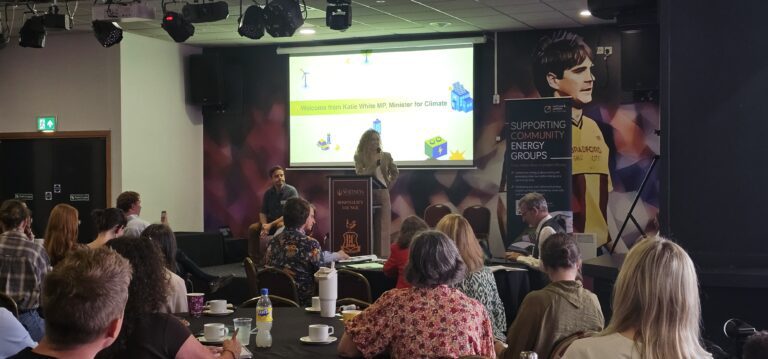
Hundreds of people gathered at Bradford City’s home ground of Valley Parade to spread the message that “everything we love is powered by electricity”, with organisations from across the region sharing examples of how clean energy is supporting communities, cutting costs and inspiring local action.
The event was part of Energising Britain a national celebration of local clean energy which saw simultaneous events hosted by the Local Net Zero Hubs, with events also taking place in Bristol, Birmingham, London and Manchester.
Climate minister Katie White, in her opening address, said communities are central to the move to clean energy and that she wanted to celebrate the “magic” of people making a difference locally.
She recalled a visit to Sheffield, where she saw how a local woman called Debbie had helped restore and transform a park into “a beautiful space”, with natural flood prevention measures included as an added benefit.
“We can’t move towards a greener world without recognising the magic of people who make a difference,” White said.
“It’s not the government – it’s people, communities and stories that make things happen.”
That focus on visible, local examples ran through the day’s discussions, including at Bradford City AFC, which has been recognised with an EFL Environment Award.
Adam Keizer, from Bradford City, said the club is committed to creating a greener future not just for football, but for local communities.
“Football is more than just a game – when I go with my son, I look at him and remember going to games with my dad,” he said.
“To be able to tell supporters that their matchday experience is powered 99% by clean energy alongside the fact that their matchday experience hasn’t changed, goes a long way when inspiring members of the community.”
The club’s stadium currently has 472 solar panels and has been praised for its work in inspiring local people to make sustainable changes.
Another landmark example came from York Minster, which has recently revealed that it has reduced its electricity bills by 30% since installing 184 solar panels on its south quire roof. The Minster also uses air source heat pumps to heat parts of the site.
Alex McCallion, from York Chapter, said he hopes the project can encourage other landmarks and heritage sites to adopt clean energy.
“The symbolism of having solar panels on a building that is a symbol of the entire county can inspire people, making it easier for other heritage sites to follow suit after seeing how much community support there is,” he said.
“If York Minster can do it – anyone can.”
Clean energy in farming was also highlighted through South Yorkshire Ecofit’s “ReMooable Energy” project, which is working with the family-owned dairy farm Our Cow Molly.
The farm already has solar power on its shed roofs and hopes one day to generate energy using waste produced by its cows.
“Who doesn’t love ice-cream, and everything they make on the farm is powered by electricity,” said Lizzie Stygall, from the ReMooable Energy project.
“Making clean energy improves carbon emissions but also increases a farm’s resistance to surging gas prices.”
The event also showcased how younger people are taking practical action in their own communities.
Pupils from the Eco-Group at LIFT Feversham Primary School in Bradford said teachers were “filled with dread” about visits from the diligent youngsters, who checked for anything wasting electricity.
The school also has a clean air initiative and an orchard which provides fruit for the school kitchen.
In the North East, East Durham Trust shared its community energy initiative, Energising Durham, which helps local people save money and use less energy as prices rise.
Craig Richardson, from the trust, said its Solar Conversation project encourages people who do not trust solar energy to come together and find common ground.
“Making change rarely happens by having the right answers – more often, it’s about asking the right questions,” he said.
“The project encouraged people to have conversations despite differences in views.
“By having conversations, we learned how important it is for communities to have a voice, so they no longer feel decisions about clean energy are being made without them – but for them.”
Across the day, speakers returned to the idea that clean energy is most powerful when people can see how it connects to the things they already care about.
From football and farming to schools, heritage buildings and community energy advice, the North East and Yorkshire event showed how the transition is already helping local places cut costs, build trust and take practical action.
Communities in Action Spotlight: Sustainable Ferriby
Sustainable Ferriby is a community interest company in East Yorkshire, dedicated to empowering and inspiring locals to make the change to clean energy. The organisation has funded solar panels for a community allotment and social club and worked with their local council to install solar panels as part of renovations to a local school. Sustainable Ferriby’s activity over the past 3 years has had a ripple-effect on the local community – with two dozen Ferriby locals installing rooftop solar panels as a result of their work.
Sustainable Ferriby’s director, Simon Hudson, was the first person in the village to install solar panels and now dedicates his time to inspiring others to do the same. The organisation’s ultimate goal is to establish a network of community energy projects to generate surplus energy for residents at lower rates in the face of rising energy costs.
The CIC also works to educate villagers on the benefits of sustainable energy.
“People don’t really understand the benefits of sustainable energy until it’s explained to them. There’s a lot of understandable fear about doing something new. We make it easier for them to believe in it.” Simon Hudson, Sustainable Ferriby Founder
Their project to install solar panels on the roof of a building at a local allotment, housing an Edwardian water pump, not only saved the venue money but accelerated their move to clean energy:
“Installing a power line to the site would have cost a fortune. As it was, we have clean energy from the solar panels, and a lighter mower to remove the problem of storing petrol on-site. We’ve also got a place where people can charge their tools, and even a power source for lighting.” Alistair Green, Allotment vice-chairman
The organisation now hopes to encourage Northern Premier League team North Ferriby FC to incorporate solar panels into their stadium and is exploring ways to incorporate sustainability in local school curriculums.
This news story was produced by event partner the Local Storytelling Exchange.
Other reports from the event are available from the Bradford Telegraph and Argus and MagNorth