
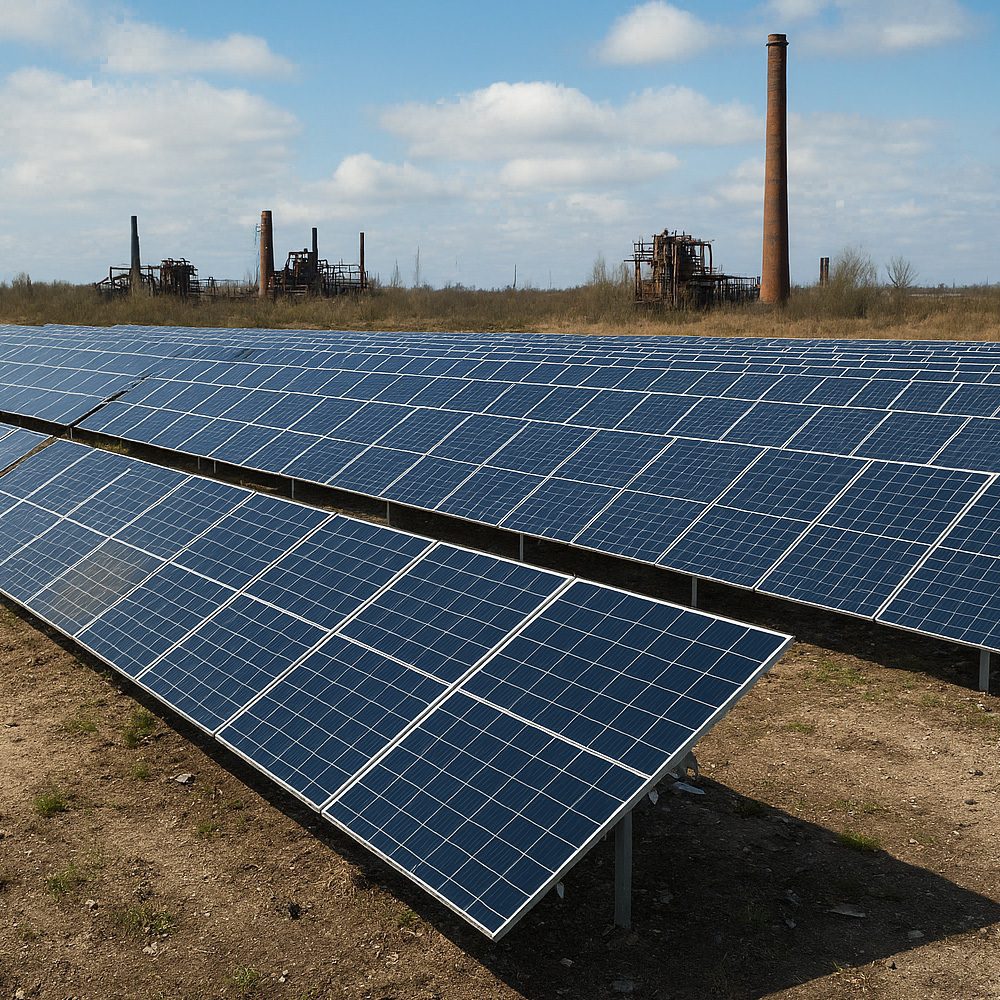
The study explored:
The assessment concluded that solar PV represented the most technically and socially deliverable option for both land parcels.
1. Grid Capacity Constraints
The local electricity network could accommodate up to 1.8 MW of new generation without reinforcement. Above this threshold, connection costs increased significantly, limiting feasible system size and shaping design choices.
2. Ground Conditions & Access
Both land parcels showed signs of likely contamination and uneven ground, typical of historic industrial use.
Access routes required negotiation across third‑party or non‑highway land, adding complexity for construction and cable routing.
3. Planning Sensitivity for Wind Development
Although one parcel fell within a designated area for wind, historic public opposition in the wider locality created elevated planning risk. Solar PV presented a far lower planning and engagement risk profile.
4. Ecological Considerations
Both sites are located near ecologically sensitive areas, requiring surveys and possible mitigation. One parcel bordered a wildlife corridor, increasing ecological sensitivity.
5. Uncertainty Around Future Adjacent Land Uses
With several nearby areas undergoing regeneration, long‑term energy demand and land-use patterns were uncertain – an important factor for any future private-wire arrangements.
The following outcomes were delivered and learnings made.
The study identified that:
Annual generation potential:
For the smaller parcel, exporting electricity to the grid yielded:
This approach avoided complex contractual arrangements while maintaining project viability.
Where local supply was possible, a 1.8 MW system supplying a neighbouring high‑demand user achieved:
A larger 6.3 MW array (with grid export capped at 1.8 MW) also demonstrated strong returns, although relying on stable long-term energy demand introduces commercial risk.
Across the recommended system sizes:
Over a 25‑year lifetime, combined schemes could prevent over 16,000 tCO₂e.
Modelling indicated that:
The analysis demonstrates strong alignment with: